This post links to our product pages, which carry affiliate links. If you buy through them, we may earn a small commission at no extra cost to you.
A freestone trout stream in January can feel empty. The water is in the thirties, and a whole afternoon can pass without a take. Drive to the river below a dam on the same day and you will often find trout feeding steadily by early afternoon. The catch is the size of what they are eating. Most of it is midge larvae and pupae, and a fly that would look small in June is too big here.
Why tailwaters keep fishing in winter
Most of the well-known trout tailwaters are fed from the bottom of the reservoir. As a lake cools in late fall it turns over, and in a cold winter its coldest water sits near the surface while slightly warmer water settles to the bottom, where the outlet is. So the dam releases water that is warmer than the air and warmer than nearby freestone streams, and the river stays open for miles below it.
How warm depends on the dam. The San Juan below Navajo Dam was running about 40 to 44°F in mid-January this year. Arkansas's Little Red River below Greers Ferry Dam is reported at 45 to 55°F all year, and the Cumberland below Kentucky's Wolf Creek Dam held around 55°F in early December 2019. A few degrees is enough to keep insects hatching and trout feeding, which is why a thermometer is worth carrying. The river usually cools with distance from the dam, so the first few miles fish best in the coldest weeks.
Stable flow also grows a lot of food. Weed beds below dams hold dense populations of scuds and sow bugs, silty runs hold aquatic worms, and midges hatch from almost all of it. Those are the four things to tie for, along with the small olives that appear on gray days.
Midges for winter tailwaters
On most tailwaters, midges are the winter menu. They hatch in some numbers almost every day, usually from late morning into mid-afternoon, and trout eat every stage. Most of the eating happens below the surface, on larvae and pupae drifting near the bottom.
Our Midge recipe is the adult: a cream rabbit-dubbed body with a cream hackle tail and collar on a standard dry fly hook. It is the fly for the hour when fish are sipping on soft water. Tie it sparser than seems right. The body should be a thin film of dubbing, barely thicker than the thread, and two or three turns of saddle hackle are plenty on a size 20. Hackle that fits a 20 or 22 is hard to find on an ordinary cape, so this is where a genetic midge saddle earns its price. Cream matches the paler midges, but tie some in gray and black too, since winter midges on many rivers are dark.
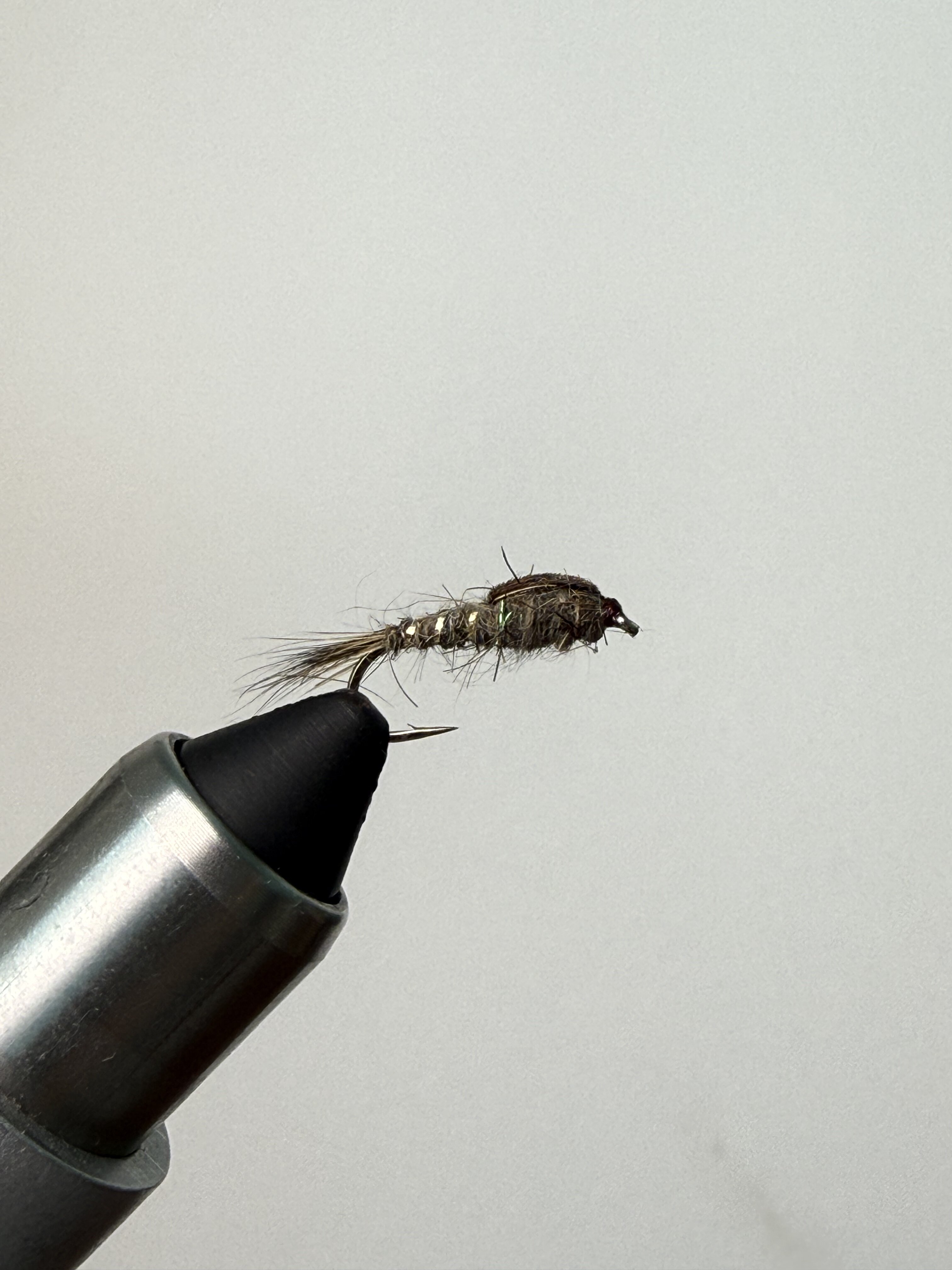
For the larvae and pupae, the fly most guides would name first is the Zebra Midge, created by Lees Ferry guide Ted Welling on the Colorado River below Glen Canyon Dam and usually dated to 1996. Our recipe is the black-and-silver standard: a black thread body, a small silver wire rib and a 1/16-inch silver bead on a 2X-short emerger hook, sizes 16 to 22. It sinks quickly and fishes well as the trailing fly in a two-fly rig. The body is the whole fly, so build a slight taper with a few layers of fine thread, then spin the bobbin to flatten the thread for the final layer so the body comes out smooth. Keep it thin enough that the wire rib sits in clear, evenly spaced segments. Some tiers add a thin coat of UV resin for durability. Red and olive versions both have followings.
The RS2 comes from Rim Chung, who developed it on Colorado's South Platte in the early 1970s. It is an emerger that passes for both a midge and a small olive just under the surface. Our recipe is Charlie Craven's all-synthetic version: two white microfibbet tails, gray Super Fine dubbing and a short stub wing of white Antron on a size 16 to 24 dry fly hook. Keep the abdomen to a thin film of dubbing, and trim the wing short and square just past the eye.
The Griffith's Gnat, credited to Trout Unlimited co-founder George Griffith, is a peacock herl body with grizzly hackle palmered over it, and it reads as a cluster of midges stuck together on the surface. It is easier to see than a single size 22 midge, which matters in winter light. Our recipe is written for a size 16. For winter tailwaters, tie it in 18 and 20 as well, and choose hackle whose fibers reach just to the hook point. Wrap the herl tightly and space the palmered hackle evenly, so the fly sits level in the film.
Blue-winged olives on gray days
The Blue Wing Olive covers several small olive mayflies, mostly Baetis, and on most tailwaters they are the only mayfly hatching in winter. They come off best on cold, overcast, drizzly afternoons, often in a short burst. A bright day may produce nothing.
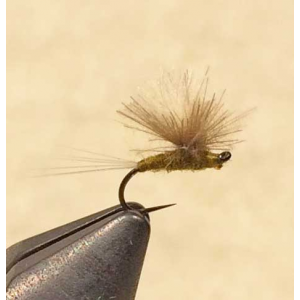
Winter and late-fall olives run small, usually 20 to 22 and on some rivers 24. Our recipe uses a dark dun tail and hackle, a rabbit dubbing body in medium olive, and gray duck quill wings. For winter, tie it at the small end and keep the body slim. Duck quill wings get hard to set cleanly below a 20, and many tiers switch to a small post of CDC or synthetic yarn at those sizes, which also helps you find the fly on dull water. Keep the tail short and sparse so the fly lands upright.
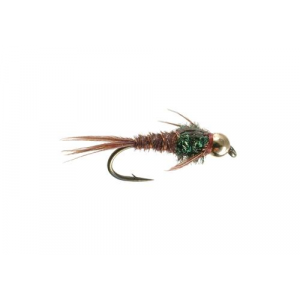
Before and during the hatch, the nymph usually outfishes the dun. The Bead Head Pheasant Tail is close in shape to a Baetis nymph: ringneck pheasant tail for the tail, body and wingcase, a copper wire rib, a peacock herl thorax and a copper bead. For winter, tie it in 18 and 20 with the smallest bead that suits the hook, or leave the bead off and let split shot do the work. The common mistake is a body built too fat, which takes away the slim nymph shape. Counter-wrap the wire rib over the pheasant fibers, so a trout's teeth don't unravel the body on the first fish.
Scuds and sow bugs
Where a tailwater has weed beds, scuds and sow bugs are often the biggest single meal available, and in winter they drift and crawl slowly enough to be easy to eat. Sow bug patterns are standard on Arkansas's White River system, where gray and tan in sizes 14 to 18 are the usual choices on the Little Red.
Our Simple Scud is Tim Flagler's version of the basic freshwater shrimp. Smoky olive Sow Scud dubbing makes the antennae, body and legs, under a back of tan and black fly speck Thin Skin, ribbed with small gold wire on a curved emerger hook, sizes 12 to 18. A curved scud hook gives the same shape. Two things make it work. Taper the dubbing at both ends so the body looks plump in the middle, and wrap the rib with firm pressure so it cuts clear segments into the shell. Then brush out the dubbing on the underside and trim the fibers to about a hook gap long for legs. Olive, tan and gray cover most scuds.
The Ray Charles Sow Bug started as a guide fly on Montana's Bighorn River in the early 1990s, and it is the quickest tie in this post. Our recipe is a body of natural ostrich herl under a strip of pearlescent Flashabou, with fluorescent orange thread on a size 16 dry fly hook. Wrap each turn of herl so it covers the bare stem of the turn before, then part the fibers down both sides before you pull the Flashabou over. Gray, tan and pink are the usual colors. It carries no weight, so it is normally fished behind something heavier.
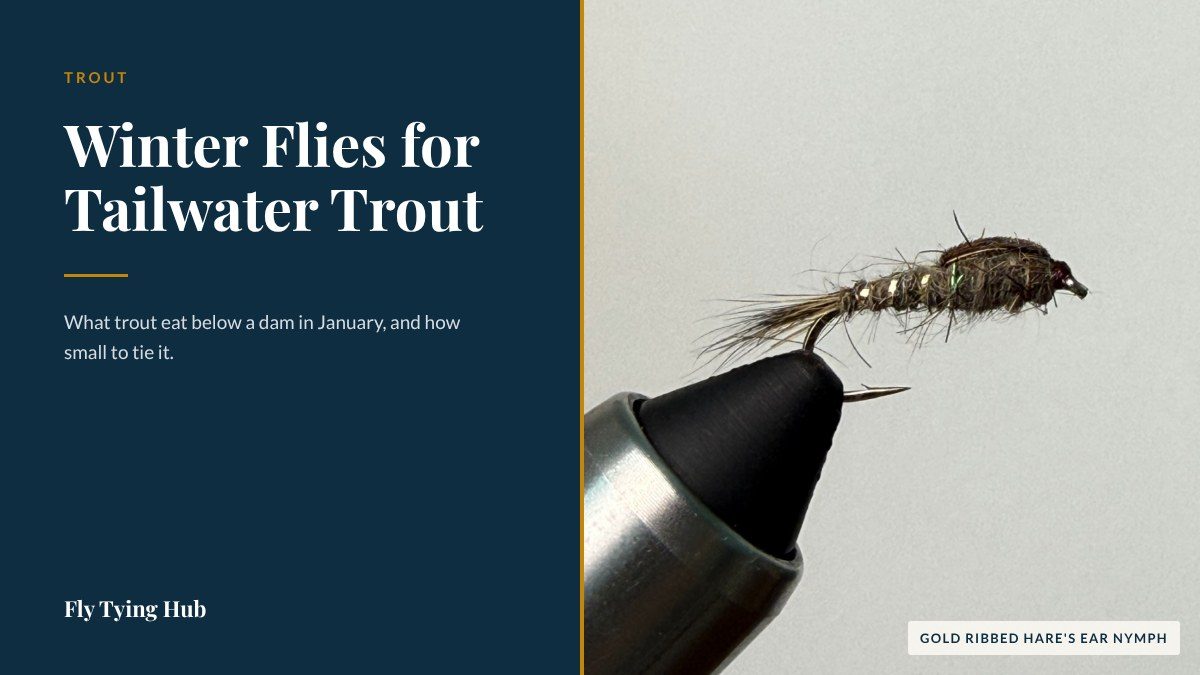
That heavier fly can be the Gold Ribbed Hare's Ear Nymph, whose rough hare's mask body also reads as a scud or sow bug. Tie it with a bead or a few wraps of wire under the body, leave the dubbing uneven, and pick out the guard hairs along the underside.
San Juan Worms after a flow change
The San Juan Worm is named for New Mexico's San Juan River below Navajo Dam, a tailwater, and it imitates the aquatic worms that live in the silt and moss of rivers like it. Worms come loose whenever the flow goes up, so on a dam with changing releases the hour after a rise is the time to tie one on.
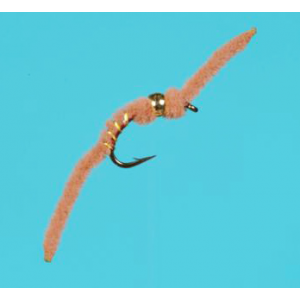
Our recipe uses a size 10 curved caddis pupa hook such as the Tiemco 2457, fluorescent red thread and fluorescent red Ultra Chenille, with an optional brass bead. Two things decide whether it survives. Tie the chenille down firmly but don't saw through it with the thread, and singe each end with a lighter so it tapers and won't fray. Red is the standard, with pink, brown and wine for different water. The Bead San Juan Worm adds a gold bead and a wire rib on a scud hook, if you'd rather the fly carried its own weight.
Rigging small flies for cold water
Two flies, big then small. The standard winter tailwater rig puts a larger fly first, usually a worm or a scud, and a small midge or olive nymph 12 to 18 inches behind it. Pat Dorsey, the South Platte guide who wrote Tying and Fishing Tailwater Flies, describes trout moving to the bigger fly and then eating the Zebra Midge. Put split shot above the first fly and set the indicator so the shot ticks bottom now and then.
Fine tippet. Tailwater trout see a lot of anglers and very clear water. 6X is the usual starting point for nymphs in sizes 18 and 20, and 7X for dries of 22 and smaller.
Slow water. In winter, fish sit in slow, deep water, such as the soft side of a seam or the deep slots between weed beds. Drift the flies through there again and again before moving on, because a cold trout won't move far for food.
Dries when heads show. When fish start rising on flat water, switch to a Midge or Griffith's Gnat, or trail a size 22 behind a more visible dry so you can follow it.
Two cautions before you go. On hydropower dams the flow can rise quickly when generation starts, so check the release schedule and keep an exit in mind when you wade. And many tailwaters carry their own regulations, such as catch-and-release sections or limits on flies and hooks, so read them for the stretch you plan to fish.