This post links to our product pages, which carry affiliate links. If you buy through them, we may earn a small commission at no extra cost to you.
A steelhead that chased a swung fly across a whole run in October won't move a foot for one in January. Most Great Lakes tributaries sit in the low to mid thirties by then, and a fish in water that cold holds low in slow current and waits for food to reach it. The fly still matters, but less than where it drifts. Small eggs and dark nymphs, fished slowly along the bottom, account for most winter fish.
When Great Lakes steelhead are in the rivers
The fall run starts entering tributaries in September and October, often on the first good rain after the water cools. Many of those fish don't go back to the lake. They spend the winter in the river, and every midwinter thaw that raises the water brings in more. Spawning runs from about March into April depending on the river and the year, and spent fish drop back toward the lake through April and into May.
That makes winter a fishery for holdover fish and fresh arrivals together, and both behave the same way once the water is cold. Look for them where the current slows to about walking pace: tailouts, the soft inside edge of a deep run, the flat water below a riffle. The fast pocket water that held fish in October is mostly empty.
On a cold, bright day the water can warm a degree or two by early afternoon. Many anglers find that is when fish start feeding, and plan their best water for midday rather than first light.
What they eat in winter
Eggs come first. Salmon finish spawning in the fall and brown trout into early winter, so loose eggs are much scarcer by January than in November. Steelhead keep taking egg flies anyway, and on most Great Lakes rivers an egg is still the first fly to tie on. Toward spring the eggs come back: steelhead spawn, and in many tributaries suckers spawn soon after.
Nymphs are the other half of the diet. Stonefly nymphs live in the gravel all year, and many of these rivers have small black stoneflies that hatch in late winter. Some Michigan rivers with silty stretches also hold burrowing Hexagenia nymphs, and Hex patterns have a following there. Leeches and sculpins round it out. Neither is a staple, but a dark leech or a sculpin is a good change when the eggs and nymphs stop working.
Egg flies for Great Lakes winter fish
Glo Bug
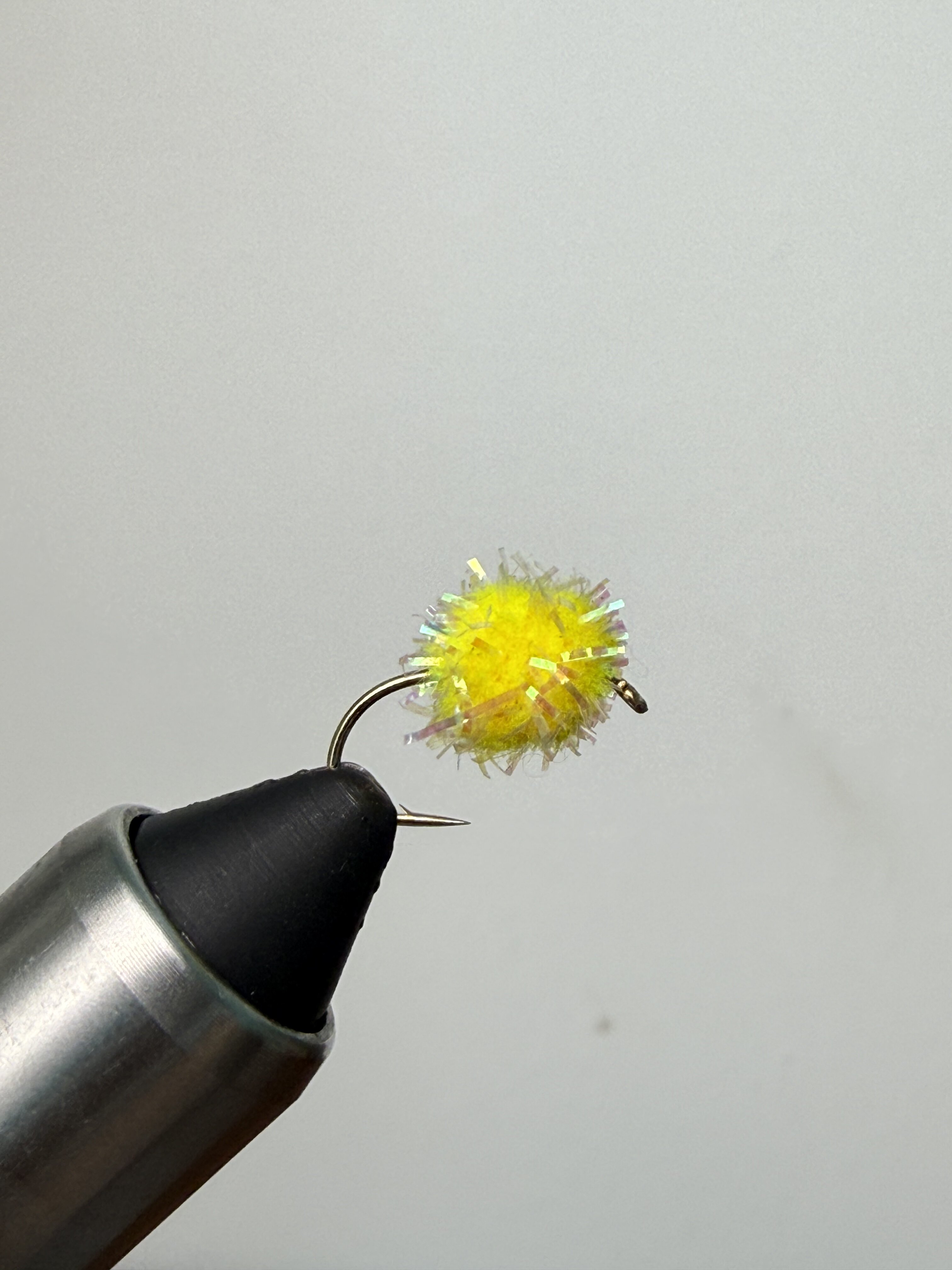
The Glo Bug is a few turns of thread and a clump of yarn trimmed round, which is why it gets tied by the dozen. Our recipe uses a size 12 egg hook, orange 6/0 thread and Glo Bug Yarn, with a contrasting blood dot of Micro Glo Bug Yarn.
For winter, change the size and the colors:
- Size. Low, clear winter water favors a smaller, sparser egg than the fall run does. Drop a hook size or two and use less yarn, so the trimmed egg looks like one loose egg rather than a pom-pom. The common mistake is too much yarn, which turns out a dense ball rather than an egg.
- Color. Eggs bleach pale as they drift, so in clear water muted shades usually outfish bright ones: peach, apricot, pale pink, cream. When rain or snowmelt colors the river, switch to chartreuse, bright orange or yellow, which stay visible in stained water. A blood dot helps in either.
- Weight. A Glo Bug carries none. Depth comes from split shot on the leader, which lets the egg drift as freely as a real one.
Nuke Egg
The Nuke Egg is the clear-water answer to a Glo Bug. Our recipe builds a small orange core from one strip of McFly Foam and wraps it in a veil of milky white Hareline Egg Veil, which turns translucent once wet, so the fly reads as a single egg with a bright yolk rather than a solid ball. It is tied in sizes 8 to 14 on a heavy wide-gap hook. Keep the veil thin: a few fibers spread evenly around the core look right, and a thick veil hides the core. Trim the veil fibers clear of the hook point.
Sucker Spawn
The Sucker Spawn imitates a cluster of sucker eggs, and it is a spring fly on many Lake Erie and Lake Ontario tributaries once suckers start to spawn. Have a few tied before March. Our version stacks small loops of Angora yarn, in salmon-egg and flesh colors, along a size 12 or 14 short-shank hook over a short Krystal Flash tail. Alternate the side each loop sits on and let the middle loops stand slightly taller than the ends, which gives the cluster its shape.
Nymphs for Great Lakes winter fish
Rusher's Steelhead Nymph
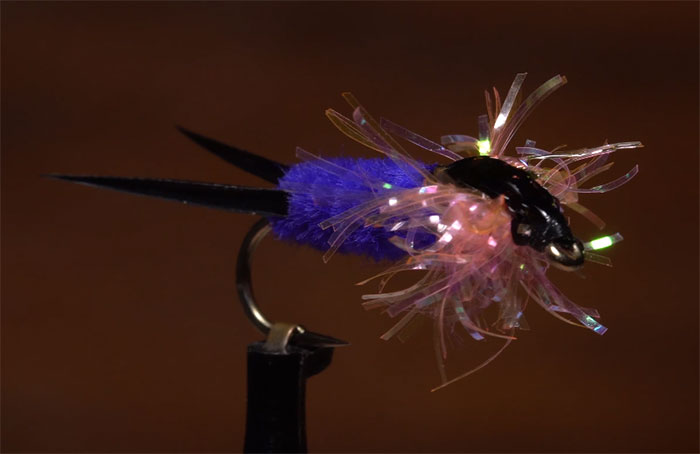
The Rusher's Steelhead Nymph is credited to Jim Rusher and associated with New York's Salmon River. It has the outline of a stonefly nymph, with a split biot tail and a wingcase, but a bright body, so it works both as food and as an attractor. That makes it a good second fly behind an egg.
Our recipe uses a 2X-long nymph hook, an Ultra Chenille body, a tail of black goose biots, a black Diamond Braid wingcase and an Estaz thorax. Keep the body evenly tapered, the two biots clearly split, and the Estaz thorax compact, because a fat thorax hides the nymph shape. Bright body colors suit stained water; purple and other darker shades are the usual choice once the river clears. Like the Glo Bug, it carries no weight.
Montana Stonefly
The Montana Stonefly covers the larger dark stonefly nymphs. Black chenille body and wingcase, a yellow chenille thorax, black hackle through the thorax, tied on a 3X-long nymph hook. This is the fly to weight: a few wraps of lead-free wire under the body help it hold the bottom as the lead fly of a two-nymph rig. Build an even body over the wraps, and keep the hackle sparse enough to move.
For a more realistic lead fly, our Black Stonefly is a heavy size 8 nymph: lead wire under a segmented larva lace body, goose biot tails and legs, and a Thin Skin wingcase. The small black stoneflies that hatch in late winter are a good deal smaller than either fly, so in clear water a small, dark Bead Head Pheasant Tail is the closer dropper.
Hex nymphs
On Michigan rivers with Hexagenia, a Hex nymph is worth carrying all winter. The Rabbit Strip Hex is the fishing version: a size 4 hook, a trimmed gold-variant rabbit strip tail for movement, a cream dubbed body, mono eyes, and a mottled Thin Skin wingcase pulled over the eyes. The rabbit tail does the work on a slow drift, so trim it to a nymph's length rather than leaving a long streamer tail. For a closer imitation, the Hexagenia Nymph uses a size 8 curved hook, pheasant gills and a copper-ribbed cream body. It takes longer to tie but matches the natural more closely.
Leeches and sculpins for Great Lakes winter fish
Egg Sucking Leech
The Egg Sucking Leech pairs a dark leech body with a bright head that reads as an egg. Our version is compact: a 2X-long, 2X-heavy hook, a dark-brown marabou blood quill tail, a chocolate-brown dubbed body ribbed with silver wire, and a 1/8-inch fluorescent fire-orange bead. The bead is both the egg and the weight. Keep the marabou tail short enough not to foul around the hook, and leave room behind the bead for a clean finish. Black and purple are the other common colors.
A black Woolly Bugger does the same job and is quicker to tie in quantity. For float fishing, the Jig-a-Bugger puts a bugger's marabou, chenille and hackle on a painted jig head, which hangs level under a float and rides hook-up over the rocks.
Muddler Minnow
The Muddler Minnow was designed as a sculpin. Don Gapen created it in the 1930s for brook trout on Ontario's Nipigon River, which runs into Lake Superior. For winter steelhead, tie it weighted and fish it slowly near the bottom on a swing, rather than the unweighted, surface-skated version.
How to fish them in cold water
Under an indicator. This is how most Great Lakes winter fish are caught. Run a single egg, or an egg with a nymph 12 to 18 inches behind it, under a float or indicator with split shot above the flies. Set the depth so the shot ticks bottom now and then. If the indicator never hesitates, the flies are too high. On smaller tributaries, tight-line or Euro-style nymphing does the same job with more feel.
On the swing. Swinging still works, but slowly. Use a sink tip heavy enough to reach the bottom, cast farther downstream than you would in the fall, and mend to slow the fly until it crosses the run at a crawl. A fish that ignores a fast swing will often take a leech that hangs in front of it. On the coldest days, the same leech dead-drifted under an indicator often does better.
Before you add a second fly, read the current regulations for the river. Several Great Lakes states, and some individual rivers, limit the number of hooks on a line or how weight and leader may be rigged. New York's Salmon River is the best-known example, and the rules differ enough from one tributary to the next that it is worth checking each one.