This post links to our product pages, which carry affiliate links. If you buy through them, we may earn a small commission at no extra cost to you.
A summer steelhead will sometimes come up through several feet of clear water to take a fly swung just under the surface. A winter fish in a cold coastal river usually won't. In water in the high thirties it holds low in the softest current it can find and lets most things drift past, so the swung fly has to reach it. Northwest tiers have spent the better part of a century working out how to get it there, and the flies below are a record of their answers.
On Great Lakes tributaries the winter answer is mostly eggs and nymphs drifted along the bottom, which is the subject of Great Lakes Winter Steelhead Flies. In the Northwest the tradition is the swung fly, and the argument has been about how to weight it.
When the fish are in
Winter steelhead start entering Northwest rivers as early as late November, usually after the first big pushes of rain. January through March is the prime time on most rivers. The Olympic Peninsula, the North Umpqua and the northern Oregon coast can fish well into mid-April. The early fish are often hatchery steelhead and the wild fish come later. On Oregon's Necanicum, for example, ODFW puts hatchery fish in the river from mid-November to early February and wild fish from mid-January through March.
Check the rules before every trip, not just at the start of the season. Many rivers require wild fish to be released, and seasons change by emergency rule. In 2026 the Skagit and Sauk catch-and-release season never opened, even though the forecast of 4,557 wild fish cleared the threshold for one, because the state did not fund the monitoring the fishery's federal permit requires. Washington plans its coastal steelhead seasons each year and announces them in December. The current rules are on the WDFW and ODFW emergency-rule pages.
The first answer: hairwings on a sinking line
The early Northwest steelhead flies were bright bucktails and hairwings. Trey Combs, writing in The American Fly Fisher, lists Ken McLeod's Skykomish Sunrise and Clarence Shoff's Polar Shrimp among the standards that went on to produce hundreds of similar patterns. Winter versions were heavily weighted and fished on sinking lines, later on shooting heads, because anglers believed "the fly needed to be carried to the steelhead." Combs also notes the cost. The weighted flies were less stable, and on a hard swing some of them came through upside down.
That is still the first tying lesson for a winter hairwing. Get the depth from the line and tie the fly to swim upright.
The best-known of these flies is the Skykomish Sunrise: a red chenille body ribbed with oval silver tinsel, a red and yellow tail, red and yellow hackle wound together, and a white calf-tail wing. Ken McLeod and his son George are credited with it. In Combs's telling, it was named for a winter sunrise over the Cascades on the drive to the Skykomish. Combs dates that drive to 1936, other accounts say 1938, and some say the 1940s.
Polar Shrimp
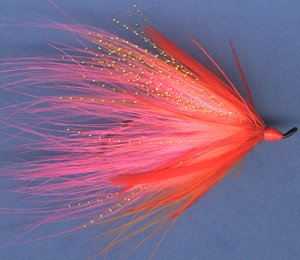
The Polar Shrimp is fluorescent orange under a white wing. It may suggest a shrimp or a cluster of eggs, but it works as an attractor, and it is at its best in cold, high, stained or glacial water, where a dull fly disappears. Its origin is disputed. It is often credited to Oregon's Polly Rosborough, but Combs credits Clarence Shoff, a tackle dealer and fly wholesaler in Kent, Washington.
Our recipe calls for a salmon hook in sizes 2/0 to 6. For winter, tie it at the large end of that range. Keep the orange hackle-fiber tail short, and use a soft hackle for the collar so it folds back and breathes rather than standing stiff. The wing is white calf tail, bucktail or a synthetic. Calf tail is crinkly and makes a fuller wing, while bucktail is longer and straighter. Either way, keep it sparse and tie it directly on top of the shank, just reaching the end of the tail. A wing that slips to one side tends to make the fly swim tilted.
Skunk
The Skunk started as a summer fly, closely tied to the North Umpqua. It has a place in a winter box as the dark fly, with a black body and hackle, a red tail and a white wing, for low light and clearer water. Its origin is uncertain. Mildred Krogel of Roseburg is often credited, and some accounts give it to Seattle's Wes Drain.
Our recipe is a modern version. It has a black Polar Dubbing body ribbed with silver tinsel, a sparse purple Flashabou underwing, a white calf-tail wing and a narrow orange calf-tail overwing. The orange is only a few hairs, and the body should stay slim enough that the rib shows.
Glasso's Spey flies, and the dry line
In the late 1950s Syd Glasso, a schoolteacher in Forks on the Olympic Peninsula, began tying steelhead versions of the old Scottish Spey flies for rivers like the Sol Duc. A Spey fly's long body hackle moves in slow current without needing speed, which is exactly what a cold fish in soft water requires.
The Brown Heron is one of Glasso's. The rear two-thirds of the body is fluorescent orange floss and the front third is orange dubbing. A long gray hackle is palmered through the body, with a teal throat and a low wing of bronze mallard. Tie the hackle in by its tip at the back, palmer it forward in open turns, and stroke the fibers back after each turn. Then counter-wrap the oval silver rib forward through it, so a broken stem doesn't unravel the hackle. Heron is protected and can't legally be used in the US, so the recipe lists substitutes: blue-eared pheasant, ring-necked pheasant rump or schlappen. For the dubbing, goat, Antron or a seal substitute all work. Real seal fur is restricted in the US, and our seal group carries substitutes only. Set the mallard slips low over the body, like a tent, and keep the whole dressing sparse.
Not everyone went deep. Bill McMillan of Washougal, Washington, is one of the best-known advocates of the dry line: a floating line and a lightly weighted fly swung slowly near the surface, even for winter fish. He created his Winter's Hope in 1971: a flat silver body, a blue hackle collar with a slightly longer purple one in front of it, and a wing of hackle tips. The wing is the fiddly part. Two yellow tips go dull side to dull side, with an orange tip on each side enveloping them, and our recipe adds a sparse topping of golden olive calf tail. Spey flies and the dry line suit clear water and the milder end of the season best. When the river is cold and high, a sink-tip is the more common choice.
Marabou: movement without current
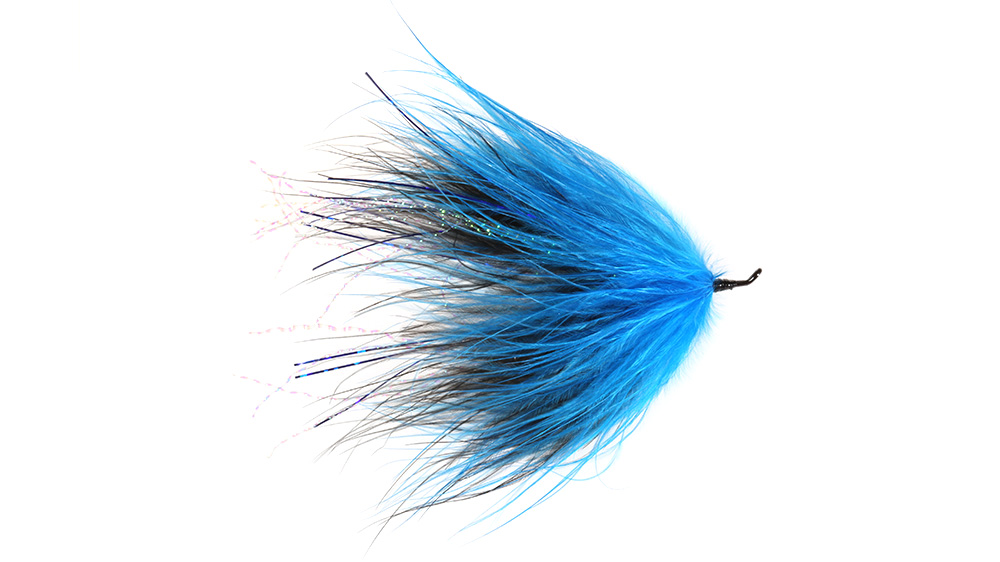
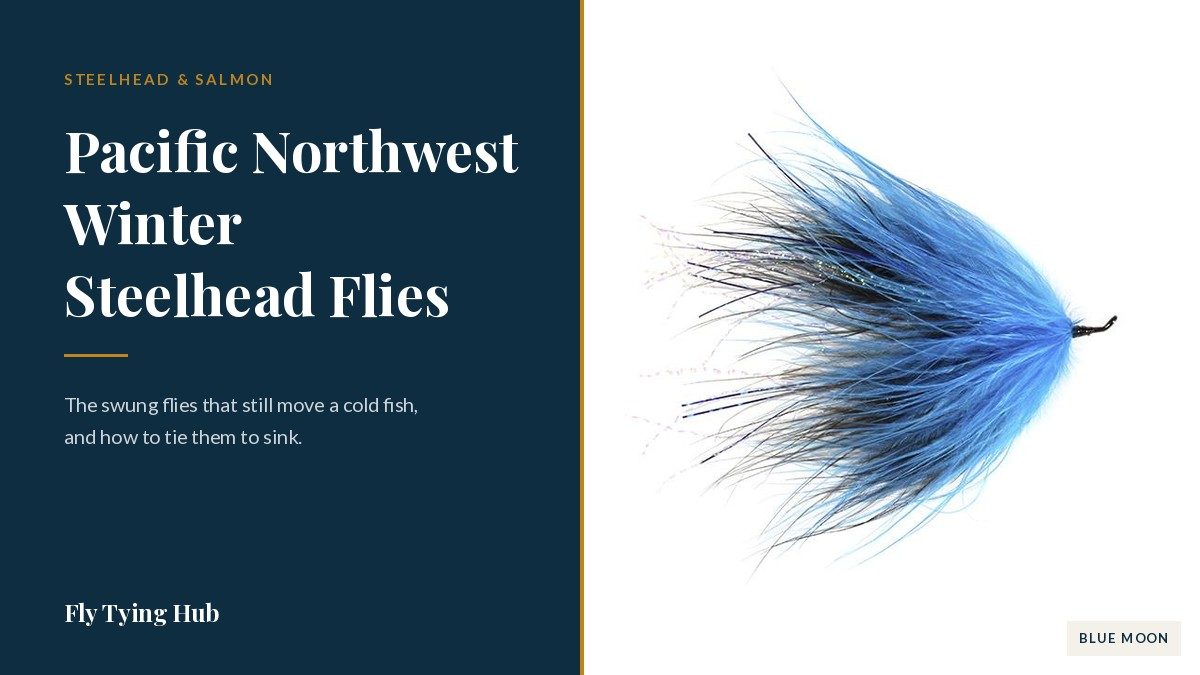
George Cook developed his Alaskabou flies while guiding in Alaska in the 1980s, as fly-rod answers to the flashy spinners and spoons salmon anglers were using. Two of them became winter steelhead flies. Our recipe notes that the Tequila Sunrise became a favorite on the Sauk, Skagit and Skykomish, and that the black-and-blue Blue Moon is popular for winter fish, low light and glacial or lightly stained water. The reason is simple. Marabou moves in almost no current, and almost no current is where a winter fish lies.
Both are tied on a 1/0 salmon hook by winding marabou like a hackle, a few turns at each position. The Tequila Sunrise has pink marabou wound about a third of the way back on the shank, salmon-orange in front of it, a few strands of orange Krystal Flash mixed through, and a red schlappen collar. The Blue Moon is long black marabou with blue flash, finished with blue in front. The common mistake is too much marabou. It soaks up water, and a bushy one casts like a wet sock and swims no better than a sparse one.
For depth, the Blue Moon recipe mentions tube versions and a cone head at the front. The General Practitioner, Esmond Drury's 1953 Atlantic salmon shrimp, belongs in the same box: our recipe notes that black versions are popular for winter steelhead in the Northwest and British Columbia.
The Intruder
The fly that has arguably changed winter steelheading most is the Intruder. In the early 1990s Ed Ward, guiding in Alaska with Jerry French and Scott Howell, designed the first Intruder for king salmon. It was a way to get a huge, plug-like outline without the weight and bulk of a fly tied on a giant hook. Ward soon took it to his home river, the Skagit. The Intruder is built on a bare shank, with a short hook trailing behind on a loop, usually rigged point-up so it rides over rocks. It casts and sinks better than its size suggests because the outline comes from a few long, sparse materials. Short, heavy Skagit casting heads developed alongside it on the same river, for throwing big flies on sink-tips.
Intruders vary a lot, but most share a layout: weight at the front, a short rear section that holds the long fibers out from the shank, and long, soft materials over it. Our recipe is a sparse, single-station version on a 35 mm Waddington shank, with a size 4 trailer hook on a doubled loop of 14-pound Fireline. Lead dumbbell eyes go near the front of the shank. Pink Ice Dub spun in a dubbing loop makes the rear station, and an opal tinsel body runs forward from it. Blue Arctic fox in a second loop makes the shoulder, and a sparse wing of ostrich herl and black flash goes over it, under a black marabou collar. Keep it sparse, since the point is a big outline that still sinks. Glue the trailer loop where it is tied to the shank, because that is where an Intruder usually fails. We don't carry shanks, tubes or trailer hooks yet, so for those you will need a fly shop.
Where to put the weight
Every one of these flies is an answer to the same problem, and the answer you tie decides how the fly behaves on the swing.
Hairwings and Spey flies are usually best tied unweighted, with the sink-tip doing the work. If you want a little weight, a few turns of lead wire centered on the shank under the body keeps it close to balanced. Combs's warning about flies rolling over still applies to anything heavier.
Marabou flies take weight at the head. A cone or a weighted tube gets the fly down quickly and leaves the marabou free to move behind it.
Intruders carry their weight in the eyes. Tie the same pattern with two or three eye weights and keep them in separate rows of the box.
Whichever you choose, match the fly to the tip. Flylords' advice is to pair a sink-tip and a fly that sink at roughly the same rate. A heavy fly on a heavy tip dredges along the bottom at a steep angle below the fish, and a light fly on a heavy tip rides above the tip.
Fishing them slow
When the water is below about 40°F, look for the deepest, slowest water and slow the swing down. That usually means the soft middles and tailouts of pools rather than fast riffles. Cast down and across, throw an upstream mend so the fly sinks before the line starts to pull, and lead it across with the rod tip so it crawls rather than swims. Let it hang below you for a few seconds at the end. When a fish takes, let the line come tight before you lift.
The summer flies in our directory, like the Freight Train and Silver Hilton, are tied in sizes 4 to 8. Most of the flies above sit between 2 and 2/0. If you tie a handful for a first winter, make a bright one, like a Polar Shrimp or a Tequila Sunrise, for high, colored water. Make a dark one, like a Blue Moon or a Skunk, for low light and clearer water. When neither is working, change the tip before you change the fly.